Moving into God’s marvelous light

Sunset 12-25-2020

But ye are a chosen generation, a royal priesthood, an holy nation, a peculiar people; that ye should shew forth the praises of him who hath called you out of darkness into his marvellous light:  1 Peter 2:9

This verse popped out at me this morning. There is so much involved in it. The last half of the sentence encloses a lifetime. Yes, there was a point in our lives when the Lord snatched us out of darkness. We all know the moment. Even though we can remember the moment, that moment took years of preparation for the Lord to set it up. We had to be ready. We had to be sick of living in sin. We had to be ready and searching for something more. Perhaps some who are reading this little writing are still searching. Maybe this is part of your moment.

Once we were snatched though, the real work began, that is, the Lord’s work in our lives. We can’t just say yes to God Almighty and stay the same way that we were. The Scripture says that He called us out of darkness. That means we have to leave darkness behind, and I can tell you, that is a lifetime process. The Lord is always uncovering new layers of darkness for our benefit. He never wants us to stay stagnant. With Him, it’s always, “onward and upward!”

In our world, in order to get light, you have to turn it on. You can’t stay in a dark room and expect to have light. You have to do something to get light. It’s pretty easy for us these days to get natural light, but at the same time, it doesn’t come cheap. I don’t know about where you live, but our electric bills are only moving upwards. So spiritually, what is the cost for spiritual light? Most of the time, it costs me my natural desires. “But Lord, I want to do that.” Or, Lord, “I want to think about that.” How about this one? “Lord, I want to eat that.” The Lord may not want us to have that at this moment. He knows. He may not want me to go to a certain place right now.

And be not conformed to this world: but be ye transformed by the renewing of your mind, that ye may prove what is that good, and acceptable, and perfect, will of God.  Romans 12:2

Finally, brethren, whatsoever things are true, whatsoever things are honest, whatsoever things are just, whatsoever things are pure, whatsoever things are lovely, whatsoever things are of good report; if there be any virtue, and if there be any praise, think on these things.  Philippians 4:8

By these Scriptures, we can see that it is important not just to stop natural sin, but to reform our minds.  Keeping our minds on God can be done in so many ways.  Have a chat with Him.  He’s always up for a chat with His children.  We can find out what He thinks about different issues in life.  We can ask for help.  He won’t give us a rock if you ask for a fish, but it might be a different kind of fish than we were expecting.  

All of these changes in our lives lead us to a place where we can truly say, 

Not that I speak in respect of want: for I have learned, in whatsoever state I am, therewith to be content.  Philippians 4:11

And this one as well:

Thou wilt keep him in perfect peace, whose mind is stayed on thee: because he trusteth in thee. 4Trust ye in the LORD for ever: for in the LORD JEHOVAH is everlasting strength:  Isaiah 26:3, 4

img_1518

O that thou hadst hearkened to my commandments! then had thy peace been as a river, and thy righteousness as the waves of the sea:  Isaiah 48:18

One of my dear Bible teachers who has now passed on loved to end his teachings with this next  verse.  May it be true of you.  ♥

And the God of peace shall bruise Satan under your feet shortly. The grace of our Lord Jesus Christ be with you. Amen. 

Romans 16:20


Treasure hidden in an earthen field

Sometimes God gives us a quick lesson, not wasting much time to get the message through.  On the other hand, sometimes, He builds the lesson across several years or even many years.  Perhaps lessons in marriage take many years, but here is a lesson that took more than several years for me to get.  Perhaps something similar has happened to you?

So, ‘more than several’ years ago one of my best friends gave me some plants for my garden.  I was always interested in more plants and she was extremely knowledgeable about them.  In fact, she had her own gardening company.  So, I readily accepted the plants.  In my fairly large backyard, I have one area that I call the circle garden.  It has had its problems over the years, mainly because my yard sits on what used to be one of the earlier farms in our town.  I have been digging up bricks and bits of broken pottery and pig bones for years.  As a side note, when my daughters were little, they and their friends used to dig out there.  If they found a bone, they excitedly reported that they had found a dinosaur bone.  It was a small yet fun distraction for them which lasted until a neighbor told them the truth of the matter.  Anyway, parts of the yard have always been a struggle for me.  As the years passed by, those plants from my dear friend became horribly invasive.  Ayayay!  Sadly, my friend passed away a few years after giving me the plants.  I missed her dearly, so how could I be upset with her over the invasiveness of those naughty plants?  I tried just to bury the whole thing and continued to struggle with trying to remove them.

Just a few weeks ago, I bought some plants that would attract butterflies and beneficial insects to my property and decided to plant them in ‘the circle garden’.  I began to dig, and then more digging ensued, and then I just couldn’t seem to stop.  You would be shocked at everything I dug up.  Apparently, since there were no dumps in those days, everything went into one very special place in the backyard, and this turned out to be it.  Broken pottery (lots), broken glass (lots), a rusted spoon, long rusted nails, an oblong piece of rusted metal, oyster shells, more bones, big rocks and little rocks, bricks and pieces of bricks.  And of course the invasive plants and their roots, and more roots, and more roots.  It’s a plant for which you must remove every trace of a root or that tiny trace will become a new plant.  As the digging went on and on, thoughts of my dear friend were fresh in my mind, and I found myself reflecting on my friend, our friendship, and the plants.

As my digging went deeper and further around the circle, God led my thoughts to follow suit.  Deeper and wider.  In a flash of inspiration, I realized that instead of a curse of invasive plants, my friend had given me a most exquisitely beautiful treasure.  God began to show me that first, I would never have cleaned up my backyard if it had not been for those nasty plants.  All that garbage would have still been underground, but I would have been mostly unaware of it.  More importantly, at the same time, He showed me that all of those bits of trash under the surface corresponded to things inside of me that the Lord has been helping me to dredge up and eliminate over the years.  Things in my life that were not actually mine, but just as I inherited the hidden dump in my backyard when we bought the house, I inherited characteristics from my parents and grandparents and great grandparents (and they in turn inherited from their parents) that God wanted me to cast away.  Perhaps I had my grandmother’s way of being judgmental, or my grandpa’s problem with depression, my dad’s quietness, or my mom’s sharp tongue.  I love all of these dear relatives and they passed down many wonderful traits as well: ideas, behaviors and life lessons that I will always treasure.  But it’s time to dig up all those other thoughts, feelings and behaviors that have no future place in a paradise garden.

Again, the kingdom of heaven is like unto treasure hid in a field; the which when a man hath found, he hideth, and for joy thereof goeth and selleth all that he hath, and buyeth that field.

Matthew 13:44

What do we all have hidden under the surface, somewhere deep in the recesses of our hearts?  Those things do not truly belong to us.  We are literally children of God, descendants of Adam and Eve, the son and daughter of the living God.  Any characteristic that we have inherited that doesn’t befit a child of God is not ours, and Jesus our King has given us power to get rid of it.  As our loving Father reveals what is in our heart that is not like Him, it is as a treasure hidden in a field of earth.  Not because that thing has any value of itself, but that the finding of it and eliminating it from our lives through the power given to us by Jesus is the exquisite treasure.  Why a treasure?  Because each problem that we overcome brings us that much closer to God who loves us eternally and wants us to dwell forever with Him in His paradise.

May we all have the spiritual insight to see that when problems beset us, God is setting a treasure before us.  We just have to dig it up, eliminate it from our lives, and replace it with something positive.  The true treasure is God living inside of us.  Happy digging!  Watch His life come alive in you.  🙂

But if I cast out devils by the Spirit of God, then the kingdom of God is come unto you.

Matthew 12:28

He that overcometh, the same shall be clothed in white raiment; and I will not blot out his name out of the book of life, but I will confess his name before my Father, and before his angels. 

Revelation 3:5

What? know ye not that your body is the temple of the Holy Ghost which is in you, which ye have of God, and ye are not your own?

1 Corinthians 6:19

“Holy Moments”

In the spring, a friend gave me a small book called “Holy Moments” by Matthew Kelly.  He describes a “holy moment” as:

“A Holy Moment is a single moment in which you open yourself to God.  You make yourself available to Him.  You set aside personal preference and self-interest, and for one moment you do what you prayerfully believe God is calling you to do.”

Later in the book he describes a famous Holy Moment from Victor Hugo’s epic story Les Miserables.  The story involves Jean Valjean, and a local bishop. Here are Matthew Kelly’s exact words to describe what happened in the story because he has written it so beautifully.

There is an amazing moment in Victor Hugo’s epic story Les Miserables.  The main character is a man named Jean Valjean.  Released from prison after nineteen years of hard labor for stealing a loaf of bread, he is bitter, angry, and resentful of everyone.  One evening he knocks on a door looking for food.  The owner welcomes him into his home to share a meal and to stay the night.

Valjean repays this generous hospitality by stealing his host’s silverware.  The police capture him the next day and bring him back to return the silverware.  But Valjean’s host protects his thieving guest, telling the police that the silverware was a gift.  This act of kindness, this Holy Moment, sets Valjean free in every way imaginable.

Jean Valjean’s host was an elderly bishop, a true man of God.  He knew Holy Moments had the power to ransom people from fear and hatred and return them to God.

This encounter with the bishop was the first time in decades Valjean had been treated with love, respect, and compassion.  It forever changes him.

It was a moment of tender care.  The bishop did not see Valjean as a thief and he did not see himself as a bishop.  He saw only two brothers.  In that moment nothing else mattered to him except what was best for Jean Valjean.  It was indeed a Holy Moment.

This one moment of brotherly love set off a domino effect of goodness.  As a result of the bishop’s goodness, the effect of that one Holy Moment, Valjean unleashes an astonishing wave of Holy Moments everywhere he goes for the rest of his life.  These Holy Moments touch thousands of lives and transform a whole town.

Valjean was hopeless.  Devastated by hatred and injustice, having suffered so much throughout his life, he had lost faith in himself, in others, in God, and in society.  One man restored his hope in one moment, and Jean Valjean was able to change and go on to become a universal symbol of redemption and hope.

Matthew Kelly goes on to describe the hopelessness of our world today.  He asks a question: What gives you hope?  We see hopelessness all around us on a daily basis.  It’s on the news and possibly in our own lives, but definitely in the lives of many around us, either at work, in the news, or in our families.  He says that Holy Moments can bring people hope.

We have the chance to brighten the lives of people that we meet every day.  Even just a smile, or a kind word can change someone’s day and have a ripple effect on each person that person meets for the rest of his or her day.  Kindness begets kindness.  Love begets love and gives a person hope.

The good bishop in Les Miserables also committed another act of astounding generosity.  He was promoted to the rank of bishop late in life and after becoming a bishop, he was given a beautiful mansion to live in.  When he arrived at his new home, he noticed how many rooms it had.  Then he went next door to the hospital to have a look at the hospital.  It was very small and narrow.  In the hospital, he met the director and they both strolled over to the larger house.  Bishop Myriel asked the director how many patients were in the hospital, and was told that there were twenty-six.   Then he asked the director how many beds he thought could be put into the dining room of the large house.  The director said that the big house could hold twenty beds just in the dining room.  Bishop Myriel immediately said, I’m sorry sir, but I believe there has been a mistake.  You have twenty-six people in five or six little rooms.  In this house, we just have three people in a space that could hold sixty.  It’s obvious that there has been a mistake.  Clearly you have my house and I have yours.  And just like that, he gives his sumptuous home to the hospital, all the while making it seem like it was merely a mistake.  Such on the spot generosity is completely uncommon in our days.  It clearly an example of a holy moment.

At the beginning of the book, Holy Moments, The author tells another story.  The story is about a group of monks that lost their purpose and began to bicker amongst themselves.  So they decide to send a messenger to a holy man who could tell them what to do.  The messenger goes and does find the holy man who tells the messenger to go back and tell the group of monks, “The Messiah is among you.”  The messenger does just that.  Can you imagine what happens?  Do you think the bickering can continue when they don’t know who “He” might be?

The Messiah is among you!

Since we are all children of God and Messiah is God’s beloved Son, can’t we also say, “Messiah lives among you?!  What will happen when we live with that thought central in our mind and life?  From the play, “Les Miserables”:

To love another personIs to see the face of God

If you have seven minutes to enjoy the epilogue from Les Miserables:

Does God have pain? If so, can we stop His pain?

Pain is a part of life here on earth.  We all know it in different degrees, but how can a person be relieved when the pain is severe?  Pain can be debilitating and all-consuming.  Those experiencing it search for answers in every possible avenue, from conventional medicine to alternative therapies.  Sometimes there is relief, sometimes not.  Watching a loved one in pain is also difficult and leads to feelings of helplessness.  As Christians, of course we pray for healing, but sometimes God our Father allows the pain to continue.

Has our own pain, or seeing a loved one in pain, ever brought us to considering that God could have pain?  Perhaps.  Consider these ideas.  Imagine you have children who make poor decisions.  Perhaps it started in childhood with anger over apparent injustices or hurts.  It can spiral downward and turn to increasingly poor choices and behavior.  God forbid it should continue, but it could.  You would feel a spiritual pain concerning your child’s choices.  Now, let’s take a minute to look at the actual history of mankind.  Created in perfect beauty and harmony, placed in a paradisiacal environment, and given one apparently simple instruction: you can eat from any of these trees except from that tree called the tree of the knowledge of good and evil.

We all know the story, even those of us who don’t frequent church settings.  One couple made a poor choice and it’s been downhill every since.  Sure, there have been some upswings, especially when Jesus came into the world.  Imagine our world if Jesus had not come.  We would have all continued that downward spiral with no hindrances.  God our Father tried to spare us.  He really did, and He continues to do so constantly.  That is His constant desire and effort.  So, what about His pain at seeing His own creation, made in His image, both humankind and His paradise world, in such a state as we find ourselves now?

That must hurt.  What would relief from His pain look like?  He is only and always good and only and always wants good for His children.  So, relief from his pain would have to come from us, His children, stopping our sins, turning our lives around so that we could feel comfortable chatting with our dad and having Him feel comfortable with us.

How do we do that?  Read the words of Jesus.  Carry on his legacy.  He gave commandments to his disciples.  We can search out those commandments and make them part of our lives.  Seek Him and He shall be found of you.  (Jeremiah 29:13)  Jesus’ commandments to his friends and disciples are easy to find in a Bible with his words in red print.  Some of them are found in Matthew chapter five.  He expounded on them and demonstrated how to live by them throughout his life.  He himself summarized them:

Jesus replied: “‘Love the Lord your God with all your heart and with all your soul and with all your mind.’  This is the first and greatest commandment.  And the second is like it: ‘Love your neighbor as yourself.’  All the Law and the Prophets hang on these two commandments.”

Matthew 22:37 – 40

So … can we stop God’s pain?  Yes, we can.  We can stop sinning and turn to God.  Let’s pray that America, indeed our world, and we all learn to stop sinning.

praying-hands

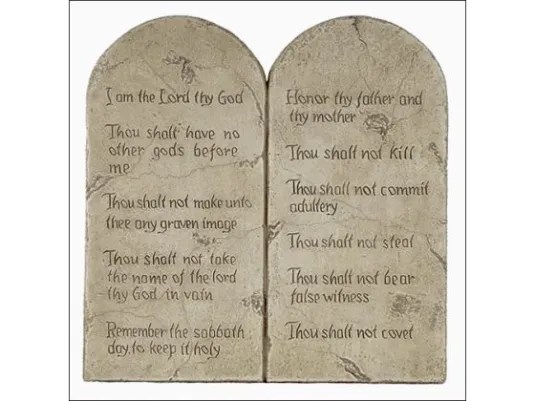
What is SO scary about the Ten Commandments?

The Ten Commandments

News: The state of Louisiana now requires that the Ten Commandments be posted in each public school classroom.  In Oklahoma, schools are now required to teach the Ten Commandments.  Why are so many outraged at this simple requirement?!

Why are people so afraid of the Ten Commandments?

  • They do not force a singular religion on anyone.  No one has to convert to the Methodist church or the Catholic church or any other church.  The first commandment only tells us to love God.  Scriptures tell us that we will be blessed if we do so.  There is proof.  When Israel obeyed God and His commandments, they were blessed.  When they didn’t, they were not blessed.  God was constantly sending prophets to them to tell them to turn back to Him and obey His commandments.
  • Many of the issues raised by the Ten Commandments are either against our laws anyway, or the issue itself is considered quite negative by most of society.  For example, adultery.  Adultery has created problems in every society throughout the world since before the commandments were even written.  Also, murder.  There is no country on earth that believes that murder is okay.  Most people also recognize that coveting the goods of others leads us down a treacherous path of negativity.  Concerning the ninth commandment (don’t lie), my grandfather used to say: “Oh what a tangled web we weave when we first practice to deceive.”  We grew up with those words stuck in our heads.  Lying was always on our radar to stay away from even though my siblings and I may have strayed here and there in our younger years.

So, why not teach the commandments to our children?  Why not try to help them avoid potential future pitfalls in their lives?

Imagine a world where the people have been taught a love for the Ten Commandments.  The murder rate would be nil or close to it.  Children would learn to love and obey their parents.  People would learn to be content with the things that God provided for them and be glad for others to have the things proper to their lives.  The bonus would be that everyone would have a a day off.  Imagine.  No going into the office.  Your boss could not even make you work from home.  A real day off.  You could spend it with your family, spend some time reading, and learning more about God from the mistakes of others recorded in the Scriptures.  You could also do some hiking or other relaxing activities to restore your body and spirit.

And yes, people would learn to love God, especially after they find out that obeying His commandments bring peace, blessing and hope for a kinder world for their children.

The Ten Commandments for kids

Mk 10:17 – 22  And when he was gone forth into the way, there came one running, and kneeled to him, and asked him, Good Master, what shall I do that I may inherit eternal life? And Jesus said unto him, Why callest thou me good? there is none good but one, that is, God. Thou knowest the commandments, Do not commit adultery, Do not kill, Do not steal, Do not bear false witness, Defraud not, Honour thy father and mother. And he answered and said unto him, Master, all these have I observed from my youth. Then Jesus beholding him loved him, and said unto him, One thing thou lackest: go thy way, sell whatsoever thou hast, and give to the poor, and thou shalt have treasure in heaven: and come, take up the cross, and follow me. And he was sad at that saying, and went away grieved: for he had great possessions.

It’s sad that the young man loved his possessions more than God.  The first commandment tells us to love God first.  It’s not hard to love God.  Start counting your blessings and see what He has done!

Our adversaries

I’ve been thinking about adversaries lately.  A friend has been having issues with it, and it reminds me of a year long trial of faith that happened in my own life several years ago.

Adversaries go back as far as Adam.  He and Eve had an adversary whose sole intention was to get them to disobey God.  He was quite the sneaky adversary, and they fell for the ruse.  Since then, adversaries are legend.  Joseph’s own brothers sold him into slavery.  When they finally met again years later, Joseph was in a position of power in Egypt.  He could have done anything he wanted to them.  He tested them, and ultimately forgave them, understanding that it was God who allowed the whole situation in order to save the lives of his entire extended family.  Jesus faced his spirit adversary in the desert and came out on top by sticking to the Scriptures and understanding them better than his rival (satan also knows the Scriptures, but obviously does not understand them.).

One of my favorite stories about adversaries outside of the Bible is in Les Miserables by Victor Hugo.  The main character, Jean Valjean,  had a lifelong adversary, Javert.  Valjean had stolen a loaf of bread and was sent to prison.  He attempted to escape, was recaptured and sentenced to a longer period of time.  He eventually managed to escape and Javert (the ever self righteous) continually pursued Valjean throughout his whole life with the goal of puttting him back in prison.  In the end (I hope I’m not ruining the story for you!), the tables are turned and Jean Valjean gets into a position of authority over Javert and even has the authorized opportunity to kill him.  However, instead of killing Javert, in a heart rending scene Jean forgives him, shows mercy to him and lets him go free.

We all wrestle with our adversary throughout our lives.  Sometimes it comes to us in a situation.  Sometimes it’s an actual person.  It can be a long term adversary or many adversaries over the years.  Why does God allow it?  Like Valjean, it’s a road we must travel to see ourselves and overcome.  It’s a road unique to us and our situation in this life.  When we see it for what it is, and learn to find the purpose for which God allowed it, we can find God on a much higher plane and become more like him.  For Valjean, in the end, he is able to say (in the musical), “to love another person is to see the face of God.”  When Jesus overcame his adversary the devil in the wilderness, the Holy Spirit entered into him with all the power he needed to complete his mission.  Ultimately, he met his human adversaries in person through Judas, the Romans, the Sanhedrin, and others who did not understand his message.  He had the power to escape it all if he wanted to.  He had already previously escaped miraculously a few times.  He had even raised Lazarus from the dead, but he willingly gave into the will of his Father and let them kill him.  While they were killing him, he said, “Father, forgive them for they know not what they do.” 

Could we say that of our adversaries?  When we meet someone who opposes us, will we resort to hatred and revenge?  Could we find such love as Jesus had, even in whatever difficulty we experience, and have that same attitude in our heart?  Would we, like Jesus, be able to maintain our faith in the Scriptures, loving and praying for the very person who is contrary to us in whatever way?

I don’t think that we can answer those questions now.  The only thing we can do is day by day, forgive those who trespass against us in our daily lives.  Even if the forgiveness is not 100% real in the beginning, practice until it is.  How do we get to Carnegie Hall?  Practice!  It’s nothing less to get to heaven.

But I say unto you, Love your enemies, bless them that curse you, do good to them that hate you, and pray for them which despitefully use you, and persecute you; That ye may be the children of your Father which is in heaven: for he maketh his sun to rise on the evil and on the good, and sendeth rain on the just and on the unjust. For if ye love them which love you, what reward have ye? do not even the publicans the same? And if ye salute your brethren only, what do ye more than others? do not even the publicans so? Be ye therefore perfect, even as your Father which is in heaven is perfect. (Matthew 5:44-48)

If you wish, enjoy the epilogue of Les Miserables at the link below.  It’s about eight minutes long.


Fixing our lives up through forgiveness

Then came Peter to him, and said, Lord, how oft shall my brother sin against me, and I forgive him? till seven times? 22Jesus saith unto him, I say not unto thee, Until seven times: but, Until seventy times seven.  Mt 18:22, 23

There are so many scriptures about forgiveness.  It’s hard to choose one among them because they are all so pertinent.  A few months ago, I was reading “The Forgiveness Fix” by Amy Newmark, which is part of the Chicken Soup for the Soul series.  The stories included are loaded with ideas about wrongs unjustly committed against others and how those who were wronged found the depth of soul to forgive.  Reading the stories made me think about people in my past whom I needed to forgive.  Some of them were from long ago and not generally part of my consciousness.  However, they were obviously not forgotten since the thought of them dredged up the same old scenarios.  There were two in particular from my days studying abroad when I was twenty.

The first one I thought of was a professor I had for French literature.  It no longer matters what happened, but the incident has stuck with me and in fact has become a story to relate to my own international students who are studying here in the United States.  It had to do with words in French and English that are “false friends.”  Both languages have the same word, but they mean something different in each language.  Anyway, I decided to look up the professor online since google has so much information.  As it turns out, I had no idea at the time that he was a famous expert in literature having written books of his own.  He not only taught us, the foreign students, but also taught native students, and it appears that his native students loved him.  Finding articles about him online helped me to appreciate him in a different light.  It became clear that it was a simple case of my misunderstanding due to the word used, combined with his deep love of great literature.  Forgiving him helped me to see that his life had meaning and goodness to a lot of people.  

The other person was a little more difficult since it involved the woman who ran the boarding house where I stayed in that country.  God gave me the power and grace to forgive her as well.  A few months after forgiving her, I was going through some old papers and found her name.  I decided to look her up as well.  This time, there was not a lot of information, but there was one small note in an old newspaper.  It was an obituary.  The obituary said that her husband had died suddenly on Christmas Eve in Holland (they may have been Dutch immigrants to the country where I was) seven years before I met her.  He was just sixty years old.  What perspective that little note gave me!  That must have been so difficult for her.  The address was the same as the place where I stayed, and so she must have been left with a very large house to run by herself, it being her only source of income.  I now believe that she was just heartbroken and bitter without much sympathy left for a naïve twenty year whose American cultural mannerisms she did not understand (and vice versa!).

From these two lessons, I have learned how truly important it is to forgive.  We have no idea what has happened in other people’s lives to make them the way they are.  We all live in our human condition, with all of the baggage that has happened in our lives.  It becomes clear why Jesus said, 

For if ye forgive men their trespasses, your heavenly Father will also forgive you: But if ye forgive not men their trespasses, neither will your Father forgive your trespasses. Mt 6:14, 15

We have such a supreme example of one who forgave the impossible.  Imagine the pain that Jesus was suffering through, not only physically, but also perhaps emotionally.  Was all of his work on earth in vain?  Where were his disciples?  We know of only one that was present at the crucifixion with his mother.  Yet, he trusted God his Father, and found the compassion and strength to think of others and to say:

Then said Jesus, Father, forgive them; for they know not what they do.  Lk 23:34

“I Believe there are Angels among us!”

I was just listening to a lovely song about angels among us.  It makes me cry every time.  There was a time when I was moving back to the U.S. after teaching in Europe for a few years.  I had some heavy suitcases (no rollers in those days!).  After a long flight, the line through customs, and a bus trip, I was exhausted and couldn’t go on as I struggled with my load while walking to my hotel.  I stopped, set down my suitcases, and told God I couldn’t go on any more.  I was at my physical end.  Instantly, a man came up to me and asked if he could help me.  Nowadays, I would probably whack him with my pocketbook, or hand over all my money.  However, I KNEW he was the answer to my cry to the Lord.  I said, “Yes, thank you.”  The man politely took the heaviest suitcase and walked me the few extra blocks to the hotel.  I thanked him and he simply left.

To this day, I know that whether human or a divine incarnation, that man was sent by God.  Sometimes, when we are new in God, He allows us to have experiences like that to increase our faith.  However, time moves on and experience begets wisdom.  As the necessary tests and trials come to strengthen us, we need to remember those early days and know of a surety, that God is still there.  He still sends those divine beings to us in our hours of need.  We may never be aware of their presence.  It becomes our duty to remember those supernatural moments early in our walk with God and cling to the knowledge that they are still walking with us every single step of the way.  “They come to you and me in our darkest hour.”

Please remember this when you are being tried and life’s struggles become too much to handle alone.  Just put down the suitcase, take a deep breath, and ask God for His assistance.  You are still His beloved child.  You are never alone.  As he left this earth, Jesus left us with these words: “Lo, I am with you alway, even unto the end of the world.”

Enjoy this beautiful song that inspired these reflections.

https://www.youtube.com/watch?v=2QF0IEU8EcQ

On becoming content

The apostle Paul said, “I have learned, in whatsoever state I am, therewith to be content.” Philippians 4:11

Wow, what an amazing sentence to be able, not only to say, but to live sincerely.  I hear a lot of whining and complaining, sometimes coming out of my mouth, but often around me when I’m out and about.  There are troublesome things outside of us that we don’t have much control over, such as, prices, crime, traffic, weather, social problems and politics, but there are also a lot of personal things, such as, jobs, bosses, husbands, wives, children, etc.  Do any of those things ring a bell?  We all have our own situations going on, our own microclimate so to speak.  And yet, Paul said, “I have learned, in whatsoever state I am, therewith to be content.”   What does it mean to be able to say that I have learned to be content?  It means:

  • I believe that all things that God allows to come my way come from my completely loving Father who only desires my eternal wellbeing.
  • Therefore, everything that happens in my life is absolutely and only for my good, even apparently negative events and situations.

Because this is true, it requires of me:

  • Complete trust in Him
  • The total letting go of fears, worries and anxiety
  • My love and devotion to loving and serving such a being that only considers what would be best for my life.

Thinking of Paul’s life, he was beaten, stoned, shipwrecked, and thrown in jail among other things.  Wow, I can’t say that I have attained to such a perfect attitude in regards to everything that has happened and is happening in my life.  Some situations have been hard and others will continue to be difficult.  And yet, …

Thou wilt keep him in perfect peace, whose mind is stayed on thee: because he trusteth in thee. Isaiah 26:3

So, how does that translate into our daily lives?

  • Say goodbye to complaining
  • No  more bad attitudes

Recently, I went to a memorial service for a dear friend who passed away.  There were several people who gave testimonials about her life.  One person said that my friend never had a bad word, ever, to say about anyone.  Several talked about her constant thoughtfulness and caring attitude.  Another talked about overhearing her praying in her office.  She was always happy, kind, and fun to be with.  In other words, she was ready to pass into the next life where the angels don’t complain about anything and don’t dare to bring railing accusations, even against the evil one.

So, in the end, we see that Paul’s simple statement is really much more than a simple statement.  It is a way of life that we need to build on day by day.  I can only stop complaining about what’s going on in my life today and look for the good.  Rainy day?  It’s good for me.  My boss is angry?  Okay, what can I learn from this?  Can’t pay my rent?  What is God showing me?  How is He leading me through this?  Life comes hard at us sometimes.  Sometimes troubles heap up in multiples and last a long time. However, even in our most troubled days, we can, one day at a time, build such an attitude and as we go along, it quietly becomes our life.  It is possible to begin to see that all of it, every bit of it, has our Father’s loving fingerprints on it, drawing us closer to Him day by day, until at last we can say, “Thank you, dear, sweet, loving and kind Lord.  Even in my darkest days, you were there, building up my relationship with you.”

The LORD hath appeared of old unto me, saying, Yea, I have loved thee with an everlasting love: therefore with lovingkindness have I drawn thee.  Jeremiah 31:3

God in a heart

Enjoy this song, The Goodness of God, sung by Cece Winans.

https://www.youtube.com/watch?v=9sE5kEnitqE

The golden nugget that is our earth

Surely there is a vein for the silver and a place for gold where they fine it.  Iron is taken out of the earth, and brass is molten out of the stone.  Job 28:1, 2

 God created this earth and placed in it everything we need, including great natural resources and treasures.  At the same time, God loves to create parables and show mysteries through them.  Jesus told us that parables teach valuable lessons to the wise, but hide those lessons from the unworthy.

Ro 1:19, 20 Because that which may be known of God is manifest in them; for God hath shewed it unto them.  For the invisible things of him from the creation of the world are clearly seen, being understood by the things that are made, even his eternal power and Godhead; so that they are without excuse:

Even our physical earth is a parable.   The fact that we must mine the precious metals out of stone shows us that there are precious treasures to be mined from this life.  Henry David Thoreau wrote: “I wanted to live deep and suck out all the marrow of life.”  There is so much to learn from this life we have.  We can suck out all the marrow of life, but sometimes it takes years to wear away the rock before the gold can shine through.

I admire my grandparents and my parents.  Because they have lived long, I can look back and see that in their younger years, they had their issues, but as they traveled through their life’s journey, somehow the rock wore away.  They changed and gained so much from living their journey.  Their lives were not easy.  I think that no one born on earth has an easy journey.  Thinking back to world events during my grandparents’ lives, they experienced World War I, followed immediately by the epidemic of the Spanish flu, then the Great Depression years and the years leading up to and through World War II.  My parents were then directly involved in World War II, even marrying just as my dad was about to be sent overseas.  World War II was followed by years of young children and financial struggles.  Once they found a little more ease and prosperity, the sixties with all of its turmoil exploded in front of their faces: the Vietnam war, upheavals throughout the country as blacks struggled to find true equality, assassinations of prominent figures including President Kennedy and Martin Luther King.   All of this immersed in a changing culture of rock music, drugs, “free love,” and demonstrations.

All of these things changed them.  As they traveled through their life’s journey, they changed and gained so much from experiencing these manifold trials.  They found confidence and peace.  They overcame impatience and anger.  They increased their love and kindness.  They learned to trust.  Through it all, they learned to pray and depend on their faith in God.  I remember my dad’s impatience and worry when I was young.  Now he is 102 years old and he doesn’t talk much any more, but when several of us gather together with him, he looks around the room and begins to cry and he says, “I love you all so much.”  Both his and my mom’s hardships turned to gold because they learned and grew from their experience here on earth.  Dad’s most recent gems were: “My wife in heaven is happy.  Pretty soon I’m going to be with her and we will be happy together.”  Then, “I’ve been praying for a long time now because I want us all to be happy with Him.”  And, “there’s lots of things to pray for.”

What golden nuggets of wisdom are we mining from our life on this ball of rock that we call Earth?  We should “suck the marrow” out of each experience.  Our exquisitely loving God and Father can only allow things into our lives that will somehow teach us something that will help us get closer to Him.  Sometimes that is a hard pill to swallow because life can be a very rocky road indeed.  Even so, let it bring out of us its golden fruit so that one day we too can say, “I’ve been praying for a long time because I want us all to be happy with Him.  There are lots of things to pray for.”